Vision Therapy in Menorca: What the Evidence Really Says?
Our optometrist Virginia attended a vision therapy course in Palma de Mallorca last October. Find out what really works and what doesn't, from Maó, Menorca.

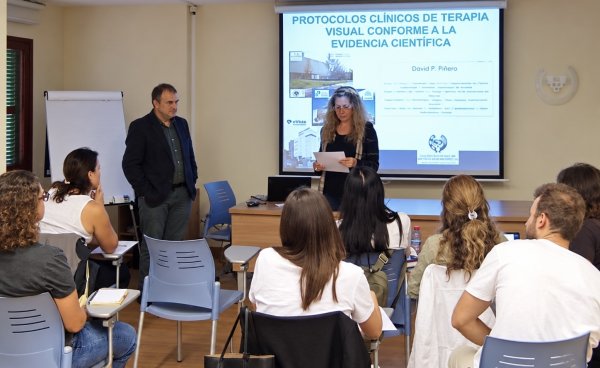
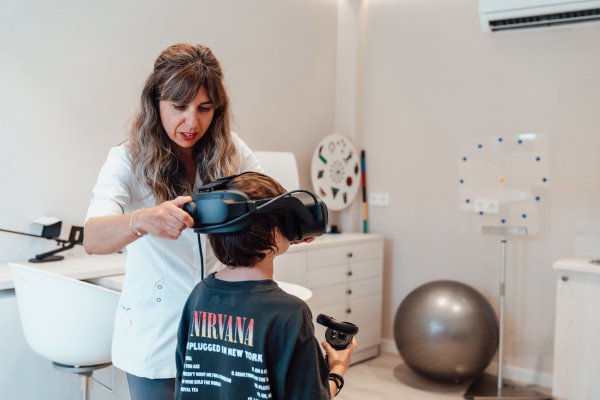
Vision therapy works, but not for everything: science clearly supports it for specific problems, such as convergence insufficiency.
That is the core message of the update course on evidence-based vision therapy that our colleague Virginia Farto, optometrist at Óptica Carreras in Maó, attended in Palma de Mallorca last October. Here is what she learned and what it means for the care you receive in Menorca.
Which course did Virginia attend, and who taught it?
The course was taught by David P. Piñero, lecturer and researcher in the Optics and Visual Perception Group at the University of Alicante and winner of the 2025 International Optometrist of the Year Award. The programme covered ten blocks: from the eye examination needed before any therapy to protocols for convergence insufficiency, focusing problems, squint, lazy eye, acquired brain injury and neurodevelopmental disorders.
The aim was very practical: using scientific criteria to decide when vision therapy is indicated, how to design a tailored programme and how to measure whether it is really working.
What is vision therapy, and what is it for?
Vision therapy is a personalised programme of exercises that improves how your eyes focus, work together and move. It is not about "strengthening muscles": what is trained is the brain's control over vision, through the repetition of very specific visual tasks.
It is just as important to know what it does not do: it does not remove your prescription or replace glasses or contact lenses. In fact, the first step is always to check that your prescription is right.
When does it work, according to the evidence?
Convergence insufficiency: the strongest evidence
Convergence insufficiency is difficulty keeping the eyes aligned when looking at something close. It can cause eye strain, headaches, double vision, losing your place when reading and even dizziness. This is the problem for which vision therapy has the most support.
A 2020 Cochrane review (Scheiman and colleagues) analysed 12 clinical trials with 1,289 participants. In children, it found high-certainty evidence that office-based therapy with home reinforcement is more effective than exercises done only at home, whether with a pencil or with computer programs not supervised by a specialist optometrist.
Focusing problems
When the focusing system struggles to switch from far to near or to keep print sharp while reading, vision therapy is the first option in many cases. These problems can sometimes affect distance vision too. There are fewer studies than for convergence, but their number has grown in recent years.
Lazy eye (amblyopia)
Here the course left a clear message: vision therapy does not necessarily replace patching, and getting rid of the patch at all costs should not be the goal. According to the evidence reviewed, combining patching with active vision therapy can speed up recovery and reduce patching time.
And where is caution needed?
- Squint (strabismus): therapy is not designed to avoid glasses or surgery when they are needed. More studies are needed and each case must be assessed individually.
- Learning difficulties: vision therapy does not treat dyslexia or ADHD. It treats visual problems that can interfere with reading, ideally alongside educational specialists and psychologists. A CITT group trial with 218 children aged 9 to 17 linked successful treatment of convergence insufficiency with fewer adverse academic behaviours.
- Neurodegenerative diseases: evidence is limited or non-existent, so no results can be promised.
What does a vision therapy programme look like in practice?
It all starts with a full examination: prescription, focusing, how both eyes work together, eye movements and a symptom questionnaire. Without that assessment, nobody can know whether therapy is indicated.
The best-supported protocols combine one weekly session at the practice with about 15 minutes of exercises at home, five days a week, for around 12 weeks. As explained on the course, clinical measurements tend to improve sooner (at about 4 weeks) than symptoms (at about 8 weeks or even later), so consistency is key. A lot depends on each case and on the work done at home.
Results tend to hold years later, although some people need maintenance exercises.
What does this change for you at Óptica Carreras?
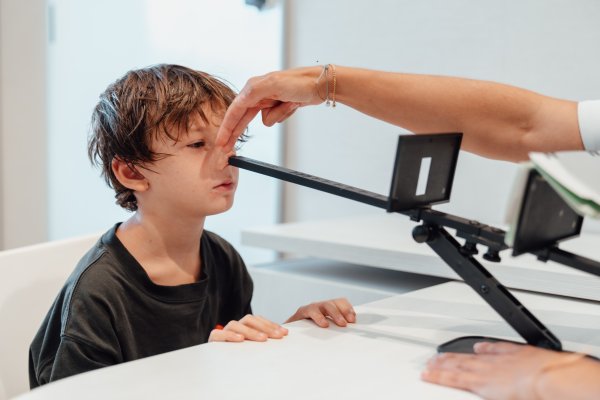
Living on an island, or spending part of the year here, should not mean settling for outdated care. That is why we train off the island and bring the knowledge home, so you do not have to catch a plane. In our vision therapy room in Maó we have been working for more than 20 years with an assessment that follows a protocol yet is tailored to each person, measurable goals and regular reviews, both for adults and in our children's optometry service.
And we make one commitment: if vision therapy is not the best option for you, we will tell you. Sometimes the answer is a new prescription, a prism or a referral to an ophthalmologist or a neurologist.
Frequently asked questions
Does vision therapy mean I won't need glasses?
No. Vision therapy improves how your eyes focus and work together, but it does not reduce your prescription, unless the cause is pseudomyopia due to accommodative excess. It usually complements optical correction rather than replacing it, and sometimes it is the only option.
How long does a vision therapy programme last?
It depends on the problem. For convergence insufficiency, the protocols with the strongest scientific support last around 12 weeks, with one weekly session at the practice and short exercises at home. For lazy eye, learning-related visual problems and some cases of squint, it can take a few months longer.
Is vision therapy only for children?
No. It can also help adults with eye strain or double vision at near or at distance. From the age of 40, prism glasses are sometimes a better option, which is why an individual assessment is essential.
Can I just do eye exercises at home on my own?
On their own, they are usually not enough. Evidence in children shows that supervised office-based therapy with home reinforcement is more effective than exercises done only at home. You need a professional who specialises in vision therapy to manage the case and adapt the exercises as the patient progresses.
Does vision therapy cure dyslexia?
No. Vision therapy does not treat dyslexia or other learning disorders. It can improve visual problems that make reading harder and that are independent of the child's disorder, always as part of coordinated work with other professionals. That is why a binocular vision examination is essential for every child with a learning disorder.
If you or your child notice tiredness when reading, headaches, double vision or trouble sustaining attention up close, book an assessment at Óptica Carreras, Costa de sa Plaça, 16, Maó (Menorca). Call us on 971 363 560, message us on WhatsApp on 693 910 684 or request your appointment here. If symptoms are severe or come on suddenly, have your eyes checked as soon as possible.
Written by Mª Gracia Carreras, optometrist.
Collegiate number: 5.232
